News

Breaking News
Loading...

Wednesday, 29 July 2015

Facts about the Resurrection of Jesus Christ

Gospel writers' accounts of Jesus' burial and resurrection
Matthew 27:59 - 28:3 And Joseph took the body and wrapped it in a clean linen cloth, 60 and laid it in his own new tomb, which he had hewn out in the rock; and he rolled a large stone against the entrance of the tomb and went away. 61 And Mary Magdalene was there, and the other Mary, sitting opposite the grave. 62 Now on the next day, the day after the preparation, the chief priests and the Pharisees gathered together with Pilate, 63 and said, "Sir, we remember that when He was still alive that deceiver said, 'After three days I am to rise again.' 64 "Therefore, give orders for the grave to be made secure until the third day, otherwise His disciples may come and steal Him away and say to the people, 'He has risen from the dead,' and the last deception will be worse than the first." 65 Pilate said to them, "You have a guard; go, make it as secure as you know how." 66 And they went and made the grave secure, and along with the guard they set a seal on the stone. 28:1 Now after the Sabbath, as it began to dawn toward the first day , of the week, Mary Magdalene and the other Mary came to look at the grave. 2 And behold, a severe earthquake had occurred, for an angel of the Lord descended from heaven and came and rolled away the stone and sat upon it.
Mark 15:44 - 16:4 Pilate wondered if He was dead by this time, and summoning the centurion, he questioned him as to whether He was already dead. 45 And ascertaining this from the centurion, he granted the body to Joseph. 46 Joseph bought a linen cloth, took Him down, wrapped Him in the linen cloth and laid Him in a tomb which had been hewn out in the rock; and he rolled a stone against the entrance of the tomb. 47 Mary Magdalene and Mary the mother of Joses were looking on to see where He was laid. 16:1 When the Sabbath was over, Mary Magdalene, and Mary the mother of James, and Salome, bought spices, so that they might come and anoint Him. 2 Very early on the first day of the week, they came to the tomb when the sun had risen. 3 They were saying to one another, "Who will roll away the stone for us from the entrance of the tomb?" 4 Looking up, they saw that the stone had been rolled away, although it was extremely large.
Luke 23:50 - 24:12 And a man named Joseph, who was a member of the Council, a good and righteous man 51 (he had not consented to their plan and action), a man from Arimathea, a city of the Jews, who was waiting for the kingdom of God; 52 this man went to Pilate and asked for the body of Jesus. 53 And he took it down and wrapped it in a linen cloth, and laid Him in a tomb cut into the rock, where no one had ever lain. 54 It was the preparation day, and the Sabbath was about to begin. 55 Now the women who had come with Him out of Galilee followed, and saw the tomb and how His body was laid. 56 Then they returned and prepared spices and perfumes. And on the Sabbath they rested according to the commandment. 24:1 But on the first day of the week, at early dawn, they came to the tomb bringing the spices which they had prepared. 2 And they found the stone rolled away from the tomb, 3 but when they entered, they did not find the body of the Lord Jesus. 4 While they were perplexed about this, behold, two men suddenly stood near them in dazzling clothing; 5 and as the women were terrified and bowed their faces to the ground, the men said to them, "Why do you seek the living One among the dead? 6 "He is not here, but He has risen. Remember how He spoke to you while He was still in Galilee, 7 saying that the Son of Man must be delivered into the hands of sinful men, and be crucified, and the third day rise again." 8 And they remembered His words, 9 and returned from the tomb and reported all these things to the eleven and to all the rest. 10 Now they were Mary Magdalene and Joanna and Mary the mother of James; also the other women with them were telling these things to the apostles. 11 But these words appeared to them as nonsense, and they would not believe them. 12 But Peter got up and ran to the tomb; stooping and looking in, he saw the linen wrappings only; and he went away to his home, marveling at what had happened.
John 19:40 - 20:8 So they took the body of Jesus and bound it in linen wrappings with the spices, as is the burial custom of the Jews. 41 Now in the place where He was crucified there was a garden, and in the garden a new tomb in which no one had yet been laid. 42 Therefore because of the Jewish day of preparation, since the tomb was nearby, they laid Jesus there. 20:1 Now on the first day of the week Mary Magdalene came early to the tomb, while it was still dark, and saw the stone already taken away from the tomb. 2 So she ran and came to Simon Peter and to the other disciple whom Jesus loved, and said to them, "They have taken away the Lord out of the tomb, and we do not know where they have laid Him." 3 So Peter and the other disciple went forth, and they were going to the tomb. 4 The two were running together; and the other disciple ran ahead faster than Peter and came to the tomb first; 5 and stooping and looking in, he saw the linen wrappings lying there; but he did not go in. 6 And so Simon Peter also came, following him, and entered the tomb; and he saw the linen wrappings lying there, 7 and the face-cloth which had been on His head, not lying with the linen wrappings, but rolled up in a place by itself. 8 So the other disciple who had first come to the tomb then also entered, and he saw and believed.
Consider the strength of the evidence
1. The large stone was moved, in spite of the Roman guards and seal
Jesus' tomb was secured in three ways:
(a) A large stone was rolled against it. It was customary to roll big stones against tombs; the stones were generally too big to be moved by just a few men, so levers were used to move them. Some have estimated that the stone that sealed Jesus' tomb weighed 1-1/2 to 2 two tons (1,361-1,814 Kilograms), which is the approximate weight of a midsize car.
(b) A Roman guard unit--which usually consisted of four soldiers--was stationed at the tomb. Roman guards were strictly disciplined fighting men held to the highest standards. Failure often required death by torturous and humiliating methods.
(c) The Roman seal was affixed to the stone that secured the tomb. The seal stood for the power and authority of the Roman Empire. Breaking the seal meant automatic execution by crucifixion upside down. Anyone trying to move the stone from the tomb's entrance would have broken the seal and thus incurred the wrath of Roman law.1
On resurrection Sunday morning, the first thing that impressed the people who approached the tomb was that the large stone was moved.3 Certainly the entire guard unit would not have fallen asleep with torture and death as the consequences. But even if the guards did fall asleep, how could thieves have sneaked by the guards and moved the massive stone without waking them up?

2. The tomb was empty
Jesus' tomb was near Jerusalem (John 19:42). Had the tomb not been empty, claims of the resurrection, which were first made in Jerusalem, could not have been maintained for even one hour-- people in Jerusalem could have gone to the tomb to check for themselves.3
Both Jewish and Roman sources and admit an empty tomb. Those resources range from Josephus to a compilation of fifth-century Jewish writings called the "Toledoth jeshu."3

3. Jesus' burial wrappings were in the tomb
The linen wrappings in the tomb amazed the disciples. Jesus had simply moved through the wrappings, apparently without a struggle, and laid the face cloth aside. Had Jesus' body been stolen, the thieves would not have taken the time to remove the wrappings or fold the face cloth.

4. There were many witnesses to Jesus' appearances
In studying an event in history, it is important to know how many participants or eyewitnesses were still alive when reports about the event were published. If the number was substantial, the event can be regarded as fairly well established, because the eyewitnesses could have refuted an inaccurate report. For instance, if several people witness a murder, and the police report about it contains numerous lies, the eyewitnesses can refute it.3
The apostle Paul wrote that Christ had been seen by more than 500 people at one time. What's more, most of the 500 were still alive when Paul was proclaiming the resurrection, so skeptics could simply question the eyewitnesses:
1 Cor 15:3-6 For I delivered to you as of first importance what I also received, that Christ died for our sins according to the Scriptures, 4 and that He was buried, and that He was raised on the third day according to the Scriptures, 5 and that He appeared to Cephas, then to the twelve. 6 After that He appeared to more than five hundred brethren at one time, most of whom remain until now, but some have fallen asleep

5. New Testament accounts were circulated among people who were alive at the time of the resurrection
Archaeological discoveries have confirmed that New Testament accounts of the resurrection were written within the lifetimes of people who were alive at the time of the resurrection. Those people could certainly have denied the accuracy of the Gospel writers' accounts.

6. The followers of Christ were persecuted and killed for proclaiming the resurrection
Jesus' disciples fled when Jesus was arrested and taken away for trial prior to being crucified. They were apparently afraid that they would be imprisoned or killed for of their association with Jesus. Peter even denied that he knew Jesus. After Jesus was crucified and buried, they remained in hiding, afraid and depressed, until Mary and others came to tell them that Jesus had risen from the dead. Why would these men, who had displayed such cowardice, risk their lives in going from city to city proclaiming the resurrection, if they did not truly believe that Jesus had risen from the dead? They certainly gained nothing for doing so. The disciples did not receive wealth or prestige for preaching the resurrection; there were no material benefits whatsoever. In fact, they were beaten, stoned to death, thrown to lions, tortured, and crucified for their preaching.3
Consider the weakness of theories given to deny the resurrection
1. Maybe the women who reported the missing body had mistakenly gone to the wrong tomb
This would mean that the disciples also went to wrong tomb.
Also, the Jewish authorities and the Roman guards were not mistaken about the location of the tomb. If the women and the disciples had gone to the wrong tomb, the Jewish and Roman authorities would have immediately produced the body of Jesus from the proper tomb in order to stop the rumor of the resurrection.3

2. Maybe those who claimed to have seen the risen Jesus were hallucinating
It's difficult to imagine that more than 500 people had the same illusion or hallucination. Here again, the Jewish and Roman authorities could have produced the body to squelch the rumor.

3. Maybe Jesus swooned
The swoon theory is that Jesus didn't die, but merely fainted from exhaustion and loss of blood. Everyone thought He was dead. When He later resuscitated, the disciples thought that He had risen from the dead.3
It contradicts medical science to believe that Jesus could have survived the crucifixion, let alone survived another two days in the tomb, removed the large stone, overpowered the Roman guards, and then convinced His followers that He had conquered death and the grave.3

4. Maybe Jesus' body was stolen
Who would have stolen the body?
As mentioned above, Jesus' disciples fled in fear when Jesus was arrested and taken away for trial prior to being crucified, and then they stayed in hiding until hearing of the resurrection. Why would these men, who had displayed such cowardice and depression, risk their lives trying to overpower the Roman guards and steal Jesus' body? And why would they have wanted to? There was nothing for them to gain by stealing the body. They were persecuted, tortured, and eventually killed for preaching the resurrection, so there was no motive for them to fabricate a lie.
What's more, even if the disciples would have wanted to maintain a conspiracy, they would not have been able.
Every conceivable method was used by Roman and Jewish officials to stop them from talking.3 Self-preservation would have eventually won over the disciples' commitment to a conspiracy. If the resurrection were a concocted hoax, the disciples would have testified against one another before succumbing to beatings or the death penalty. Think about America's Watergate: The Nixon administration, the most powerful group of men in the world at the time, could not maintain a conspiracy for even a few weeks. They buckled under pressure and chose self-preservation over maintaining a lie to save their leader.
Consider also that the Romans must not have believed that the disciples stole Jesus' body--had the officials believed it, they would have killed them for breaking the Roman seal.
Theft of Jesus' body by Jewish or Roman authorities doesn't make sense either. If the authorities had the body in their possession or knew where it was, they could have produced the body of Jesus and put an end to Christianity. But they didn't.3
Consider what historians say
Several historians have performed exhaustive evaluations of the facts surrounding the resurrection of Jesus Christ and concluded that there is no event of ancient history that is better supported by historical evidence. Statements by these historians  can be found in the book Evidence That Demands a Verdict, by Josh McDowell (see Further study, next).


Further study
For documentation of the facts presented in this article, as well as information on the reliability of the Bible, read the book Evidence That Demands a Verdict, by Josh McDowell. The book, as well as cassette tapes and books on related subjects, can be purchased from Josh McDowell Ministry, Box 1000, Dallas TX 75221, USA, Telephone 800-222-5674 or 972-907-1000.

References
1. McDowell, J. Evidence that Demands a Verdict. Here's Life Publishers, Inc., 1972,1979.
2. Ramsay, W. M. The Bearing of Recent Discovery on the Trustworthiness of the New Testament. Grand Rapids: Baker Book House, 1953.
3. McDowell, J. "Evidence for the Resurrection," Josh McDowell Ministry, 1992.

Saturday, 25 July 2015

At the heart of Christianity is a central question, "Just who is Jesus Christ?" It may be astounding to some that such a question is still relevant after nearly two millennia of Christian activity, but as strange as it may seem, even Christians do not agree about the nature of the Founder of their religion. This fact says a great deal about those who profess to be "Christian," which at its most basic means "follower of Christ." If Christians display such profound disagreement about Jesus Christ Himself, can they all really be following the same Person?
This subject becomes all the more important since, in its most common form, Christianity is proclaimed as a message about Jesus. What a person believes about Jesus, then, informs his understanding of the religion itself. We can see the result of this process in the thousands of Christian denominations in all parts of the world. While they all proclaim to be Christian, the individual sects emphasize different aspects of Jesus in their teaching. For instance:
» Baptists name themselves after Jesus' practice of baptizing converts, and they traditionally stress conformity to certain behavioral rules: no drinking, no card playing, no dancing. Jesus, to them, is a great moral Teacher.
» Pentecostals, on the other hand, call themselves after Jesus' promise of the gift of the Holy Spirit, which was fulfilled on the Feast of Pentecost after Jesus' death and resurrection. They are known for their great desire to express the gifts of the Spirit, particularly being able to speak in tongues. In other words, their Jesus is a Miracle Worker.
» Seventh-day Adventists take their name from the seventh-day Sabbath, which Jesus is plainly shown to have kept, as well as from His promise to come again. They promote Jesus as the bringer of the soon-coming rest of God.
» Methodists are so called because John Wesley emphasized a structured, methodical approach to Bible study and Christian living, teaching that believers must exercise their free will to come to Christ (as opposed to being absolutely predestined to salvation). Thus, they highlight Jesus' many commands for the individual to be actively involved in his own salvation and Christian growth.
» The Reformed Churches, descendants of the teaching of John Calvin, underscore the necessity of grace through faith in Christ, a reaction to abuses of the medieval Catholic Church's doctrine of works. In this way, they see Jesus as a gracious Redeemer.
Most denominations can be characterized—some would say caricatured—by identifying their concepts of Jesus Himself. He is Christianity's central figure, so how one views Christ determines what one believes and the religion he follows.
This confusion about Him actually began during His own life—even among those who had known Him all His life:
When He had come to His own country, He taught them in their synagogue, so that they were astonished and said, "Where did this Man get this wisdom and these mighty works? Is this not the carpenter's son? Is not His mother called Mary? And His brothers James, Joses, Simon, and Judas? And His sisters, are they not all with us? Where then did this Man get all these things?" So they were offended at Him. (Matthew 13:54-57)
It seems that there was general disagreement in Judea over just who He was:
» When Jesus came into the region of Caesarea Philippi, He asked His disciples, saying, "Who do men say that I, the Son of Man, am?" So they said, "Some say John the Baptist, some Elijah, and others Jeremiah or one of the prophets." (Matthew 16:13-14)
» And when He had come into Jerusalem, all the city was moved, saying, "Who is this?" So the multitudes said, "This is Jesus, the prophet from Nazareth of Galilee." (Matthew 21:10-11)
» Now some of them from Jerusalem said, "Is this not He whom they seek to kill? But look! He speaks boldly, and they say nothing to Him. Do the rulers know indeed that this is truly the Christ? However, we know where this Man is from; but when the Christ comes, no one knows where He is from." (John 7:25-27)
Of course, His enemies had questions about Him too:
» And the scribes and the Pharisees began to reason, saying, "Who is this who speaks blasphemies? Who can forgive sins but God alone?" (Luke 5:21)
» And those who sat at the table with Him began to say to themselves, "Who is this who even forgives sins?" (Luke 7:49)
» Therefore some of the Pharisees said, "This Man is not from God, because He does not keep the Sabbath." Others said, "How can a man who is a sinner do such signs?" And there was a division among them. (John 9:16)
However, Matthew 16:15-17 provides us with the best starting point, confirmed by Christ Himself, in answering the question, "Who is Jesus?"
He said to [His disciples], "But who do you say that I am?" Simon Peter answered and said, "You are the Christ, the Son of the living God." Jesus answered and said to him, "Blessed are you, Simon Bar-Jonah, for flesh and blood has not revealed this to you, but My Father who is in heaven."
The God-revealed answer is that Jesus is the promised Messiah, the literal Son of the Supreme Being of all the universe. Of course, He is a great deal more than this, but these two facts are the most foundational to our spiritual understanding of this wonderful Being. They give us the basis of His relationship to us and our future, as well as His relationship to Deity, fixing Him as the bridge between man and God. From this foundation, we can begin a deeper consideration of the biblical Jesus.

Friday, 24 July 2015

Historical Jesus

Existence

Most contemporary scholars of antiquity agree that Jesus existed, and most biblical scholars and classical historians see the theories of his nonexistence as effectively refuted. There is no indication that writers in antiquity who opposed Christianity questioned the existence of Jesus. There is, however, widespread disagreement among scholars on the details of the life of Jesus mentioned in the gospel narratives, and on the meaning of his teachings. Scholars differ on the historicity of specific episodes described in the biblical accounts of Jesus, and historians tend to look upon supernatural or miraculous claims about Jesus as questions of faith, rather than historical fact.

Evidence of Jesus

There is no physical or archaeological evidence for Jesus. All the sources we have are documentary, mainly Christian writings, such as the gospels and the purported letters of the apostles. The authenticity and reliability of these sources has been questioned by many scholars, and few events mentioned in the gospels are universally accepted.
In conjunction with biblical sources, three mentions of Jesus in non-Christian sources have been used in the historical analyses of the existence of Jesus.[40] These are two passages in the writings of the Jewish historian Josephus, and one from the Roman historian Tacitus.
Josephus' Antiquities of the Jews, written around 93–94 AD, includes two references to the biblical Jesus Christ in Books 18 and 20. The general scholarly view is that while the longer passage, known as the Testimonium Flavianum, is most likely not authentic in its entirety, it is broadly agreed upon that it originally consisted of an authentic nucleus, which was then subject to Christian interpolation or forgery. Of the other mention in Josephus, Josephus scholar Louis H. Feldman has stated that "few have doubted the genuineness" of Josephus' reference to Jesus in Antiquities 20, 9, 1 and it is only disputed by a small number of scholars.
Roman historian Tacitus referred to Christus and his execution by Pontius Pilate in his Annals (written ca. AD 116), book 15, chapter 44. Robert E. Van Voorst states that the very negative tone of Tacitus' comments on Christians make the passage extremely unlikely to have been forged by a Christian scribe and Boyd and Eddy state that the Tacitus reference is now widely accepted as an independent confirmation of Christ's crucifixion, although some scholars question the authenticity of the passage on various grounds.
Other considerations outside Christendom are the possible mentions of Jesus in the Talmud. The Talmud speaks in some detail of the conduct of criminal cases of Israel and gathered in one place from 200-500 C.E. "On the eve of the Passover Yeshua was hanged. For forty days before the execution took place, a herald went forth and cried, "He is going forth to be stoned because he has practised sorcery and enticed Israel to apostacy." The first date of the Sanhedrin judiciary council being recorded as functioning is 57 B.C.E.[58]

Portraits of the historical Jesus

Since the 18th century, three separate scholarly quests for the historical Jesus have taken place, each with distinct characteristics and developing new and different research criteria. The portraits of Jesus that have been constructed in these processes have often differed from each other, and from the dogmatic image portrayed in the gospel accounts. These portraits include that of Jesus as an apocalyptic prophet, charismatic healer, Cynic philosopher, Jewish Messiah and prophet of social change, but there is little scholarly agreement on a single portrait, or the methods needed to construct it. There are, however, overlapping attributes among the various portraits, and scholars who differ on some attributes may agree on others.
Contemporary scholarship, representing the "third quest," places Jesus firmly in the Jewish tradition. Leading scholars in the "third quest" include E. P. Sanders, Geza Vermes, Gerd Theissen, Christoph Burchard, and John Dominic Crossan. Jesus is seen as the founder of, in the words of E. P. Sanders, a '"renewal movement within Judaism." This scholarship suggests a continuity between Jesus' life as a wandering charismatic and the same lifestyle carried forward by followers after his death. The main criterion used to discern historical details in the "third quest" is the criterion of plausibility, relative to Jesus' Jewish context and to his influence on Christianity. The main disagreement in contemporary research is whether Jesus was apocalyptic. Most scholars conclude that he was an apocalyptic preacher, like John the Baptist and the apostle Paul. In contrast, certain prominent North American scholars, such as Burton Mack and John Dominic Crossan, advocate for a non-eschatological Jesus, one who is more of a Cynic sage than an apocalyptic preacher.

Ministry of Jesus

Works and miracles

Early Christian image of the Good Shepherd. Fourth century.
Jesus is said to have performed various miracles in the course of his ministry. These mostly consist of miraculous healing, exorcisms and dominion over other things in nature besides people.
As Albert Schweitzer showed in his Quest of the Historical Jesus, in the early 19th century, debate about the "Historical Jesus" centered on the credibility of the miracle reports. Early 19th century scholars offered three types of explanation for these miracle stories: they were regarded as supernatural events, or were "rationalized" (e.g. by Paulus), or were regarded as mythical (e.g. by Strauss).[citation needed]
Scholars in both Christian and secular traditions continue to debate how the reports of Jesus' miracles should be construed. The Christian Gospels states that Jesus has God's authoritarian power over nature, life and death, but naturalistic historians, following Strauss, generally choose either to see these stories as legend or allegory, or, for some of the miracles they follow the rationalizing method. For example, the healings and exorcisms are sometimes attributed to the placebo effect.[citation needed]

Jesus as divine

Jesus was a charismatic preacher who taught the principles of salvation, everlasting life, and the Kingdom of God. Scholars see him as accepting a divine role in the approaching apocalypse as the divine king. Jesus' use of three important terms: Messiah, Son of God, and Son of Man, reveals his understanding of his divine role.

Messiah

Main article: Messiah
In the Hebrew Bible, three classes of people are identified as "anointed," that is, "Messiahs": prophets, priests, and kings. In Jesus' time, the term Messiah was used in different ways, and no one can be sure how Jesus would even have meant it if he had accepted the term. Though Messianic expectations in general centered on the King Messiah, the Essenes expected both a kingly and a priestly figure in their eschatology.[citation needed]
The Jews of Jesus' time waited expectantly for a divine redeemer who would restore Israel, which suffered under Roman rule. John the Baptist was apparently waiting for one greater than himself, an apocalyptic figure. Christian scripture and faith acclaim Jesus as this "Messiah" ("anointed one," "Christ").

Son of God

Main article: Son of God
Paul describes God as declaring Jesus to be the Son of God by raising him from the dead, and Sanders argues Mark portrays God as adopting Jesus as his son at his baptism, although many others do not accept this interpretation of Mark. Sanders argues that for Jesus to be hailed as the Son of God does not mean that he is literally God's offspring Rather, it indicates a very high designation, one who stands in a special relation to God.
In the synoptic Gospels, the being of Jesus as "Son of God" corresponds exactly to the typical Hasidean from Galilee, a "pious" holy man that by God's intervention performs miracles and exorcisms.

Son of Man

Main article: Son of Man
The most literal translation here is "Son of Humanity", or "human being". Jesus uses "Son of Man" to mean sometimes "I" or a mortal in general, sometimes a divine figure destined to suffer, and sometimes a heavenly figure of judgment soon to arrive. Jesus usage of son of man in the first way is historical but without divine claim. The Son of Man as one destined to suffer seems to be, according to some, a Christian invention that does not go back to Jesus, and it is not clear whether Jesus meant himself when he spoke of the divine judge. These three uses do not appear together, such as the Son of Man who suffers and returns. Others maintain, that Jesus' use of this phrase, illustrates Jesus' self understanding as the divine representative of God.

Other depictions

The title Logos, identifying Jesus as the divine word, first appears in the Gospel of John, written c. 90-100.
Raymond E. Brown concluded that the earliest Christians did not call Jesus, "God". New Testament scholars broadly agree that Jesus did not make any implicit claims to be God. See also Divinity of Jesus and Nontrinitarianism.
Pinchas Lapide sees Jesus as a rabbi in the Hasid tradition of Hillel the Elder, Yochanan ben Zakai and Hanina Ben Dosa.[citation needed]
The gospels and Christian tradition depict Jesus as being executed at the insistence of Jewish leaders, who considered his claims to divinity to be blasphemous, see also Responsibility for the death of Jesus. Historically, Jesus seems instead to have been executed as a potential source of unrest.[16][69][70]

Jesus and John the Baptist

Main article: John the Baptist
Judean hills of Israel
Jesus began preaching, teaching, and healing after he was baptized by John the Baptist, an apocalyptic ascetic preacher who called on Jews to repent.
Jesus was apparently a follower of John, a populist and activist prophet who looked forward to divine deliverance of the Jewish homeland from the Romans. John was a major religious figure, whose movement was probably larger than Jesus' own.[72] Herod Antipas had John executed as a threat to his power.[72] In a saying thought to have been originally recorded in Q,[73] the historical Jesus defended John shortly after John's death.[74]
John's followers formed a movement that continued after his death alongside Jesus' own following.[72] John's followers apparently believed that John might have risen from the dead,[75][dubious ] an expectation that may have influenced the expectations of Jesus' followers after his own execution.[72] Some of Jesus' followers were former followers of John the Baptist.[72] Fasting and baptism, elements of John's preaching, may have entered early Christian practice as John's followers joined the movement.[72]
John Dominic Crossan portrays Jesus as rejecting John's apocalyptic eschatology in favor of a sapiential eschatology, in which cultural transformation results from humans' own actions, rather than from God's intervention.[17]
Historians consider Jesus' baptism by John to be historical, an event that early Christians would not have included in their Gospels in the absence of a "firm report".[76] Like Jesus, John and his execution are mentioned by Josephus.[72]
John the Baptist's prominence in both the Gospels and Josephus suggests that he may have been more popular than Jesus in his lifetime; also, Jesus' mission does not begin until after his baptism by John. Fredriksen suggests that it was only after Jesus' death that Jesus emerged as more influential than John. Accordingly, the Gospels project Jesus's posthumous importance back to his lifetime. One way Fredriksen believes this was accomplished was by minimizing John's importance by having John resist baptizing Jesus (Matthew), by referring to the baptism in passing (Luke), or by asserting Jesus's superiority (John).[citation needed]
Scholars posit that Jesus may have been a direct follower in John the Baptist's movement. Prominent Historical Jesus scholar John Dominic Crossan suggests that John the Baptist may have been killed for political reasons, not necessarily the personal grudge given in Mark's gospel.[77] Going into the desert and baptising in the Jordan suggests that John and his followers were purifying themselves for what they believed was God's imminent deliverance. This was reminiscent of such a crossing of the Jordan after the Exodus (see Book of Joshua), leading into the promised land of their deliverance from oppression. Jesus' teachings would later diverge from John's apocalyptic vision (though it depends which scholarly view is adopted; according to Ehrman or Sanders apocalyptic vision was the core of Jesus' teaching) which warned of "the wrath to come," as "the axe is laid to the root of the trees" and those who do not bear "good fruit" are "cut down and thrown into the fire." (Luke 3:7-9) Though John's teachings remained visible in those of Jesus, Jesus would emphasize the Kingdom of God not as imminent, but as already present and manifest through the movement's communal commitment to a relationship of equality among all members, and living by the laws of divine justice.[citation needed] All four Gospels agree that Jesus was crucified at the requested of the Jewish Sanhedrin by Pontius Pilate.[citation needed] Crucifixion was the penalty for criminals, robbers, traitors, and political insurrection, used as a symbol of Rome's absolute authority - those who stood against Rome were utterly annihilated.[citation needed]

Ministry and teachings

Main article: Ministry of Jesus
The synoptic Gospels agree that Jesus grew up in Nazareth, went to the River Jordan to meet and be baptised by the prophet John (Yohannan) the Baptist, and shortly after began healing and preaching to villagers and fishermen around the Sea of Galilee (which is actually a freshwater lake). Although there were many Phoenician, Hellenistic, and Roman cities nearby (e.g. Gesara and Gadara; Sidon and Tyre; Sepphoris and Tiberias), there is only one account of Jesus healing someone in the region of the Gadarenes found in the three synoptic Gospels (the demon called Legion), and another when he healed a Syro-Phoenician girl in the vicinity of Tyre and Sidon.[78] Otherwise, there is no record of Jesus having spent any significant amount of time in Gentile towns.[citation needed] The center of his work was Capernaum, a small town (about 500 by 350 meters, with a population of 1,500-2,000) where, according to the Gospels, he appeared at the town's synagogue (a non-sacred meeting house where Jews would often gather on the Sabbath to study the Torah), healed a paralytic, and continued seeking disciples.[citation needed]
Once Jesus established a following (although there are debates over the number of followers), he moved towards the Davidic capital of the United Monarchy, the city of Jerusalem.

Length of ministry

Historians do not know how long Jesus preached. The synoptic Gospels suggest a period of up to one year. The Gospel of John mentions three Passovers, Jesus' ministry is traditionally said to have been three years long. Jesus' ministry apparently lasted one year, possibly two.

Parables and paradoxes

Main article: Parables of Jesus
Jesus taught in parables and aphorisms. A parable is a figurative image with a single message (sometimes mistaken for an analogy, in which each element has a metaphoric meaning). An aphorism is a short, memorable turn of phrase. In Jesus' case, aphorisms often involve some paradox or reversal. Authentic parables probably include the Good Samaritan and the Parable of the Workers in the Vineyard. Authentic aphorisms include "turn the other cheek", "go the second mile", and "love your enemies".
Crossan writes that Jesus' parables worked on multiple levels at the same time, provoking discussions with his peasant audience.[17]
Jesus' parables and aphorisms circulated orally among his followers for years before they were written down and later incorporated into the Gospels. They represent the earliest Christian traditions about Jesus.[70]

Eschatology

Jesus preached mainly about the Kingdom of God. Scholars are divided over whether he was referring to an imminent apocalyptic event or the transformation of everyday life.
A great many - if not a majority - of critical Biblical scholars, going as far back as Albert Schweitzer, hold that Jesus believed that the end of history was coming within his own lifetime or within the lifetime of his contemporaries.
The evidence for this thesis comes from several verses, including the following:
  • In Mark 8:38-9:1, Jesus says that the Son of Man will come "in the glory of the Father with the holy angels" during "this adulterous generation." Indeed, he says, "there are some standing here who will not taste death until they see that the Kingdom of God has come in power."
  • In Luke 21:35-36, Jesus urges constant, unremitting preparedness on the part of his followers in light of the imminence of the end of history and the final intervention of God. "Be alert at all times, praying to have strength to flee from all these things that are about to take place and to stand in the presence of the Son of Man."
  • In Mark 13:24-27, 30, Jesus describes what will happen when the end comes, saying that "the sun will grow dark and the moon will not give its light, and the stars will be falling from heaven, and ... they will see the Son of Man coming on the clouds with great power and glory." He gives a timeline for this event: "Truly I tell you, this generation will not pass away before all these things take place."
  • The Apostle Paul also seems to have shared this expectation. Toward the end of 1 Corinthians 7, he counsels Christians to avoid getting married if they can since the end of history was imminent. Speaking to the unmarried, he writes, "I think that, in view of the impending crisis, it is well for you to remain as your are." "I mean, brothers and sisters, the appointed time has grown short ... For the present form of this world is passing away." (1 Corinthians 7:26, 29, 31) In 1 Thessalonians 4:15-17, Paul also seems to believe that he will live to witness the return of Jesus and the end of history.
According to Geza Vermes, Jesus' announcement of the imminent arrival of the Kingdom of God "was patently not fulfilled" and "created a serious embarrassment for the primitive church". According to E.P. Sanders, these eschatological sayings of Jesus are "passages that many Christian scholars would like to see vanish" as "the events they predict did not come to pass, which means that Jesus was wrong."
Robert W. Funk and colleagues, on the other hand, wrote that beginning in the 1970s, some scholars have come to reject the view of Jesus as eschatological, pointing out that he rejected the asceticism of John the Baptist and his eschatological message. In this view, the Kingdom of God is not a future state, but rather a contemporary, mysterious presence. John Dominic Crossan describes Jesus' eschatology as based on establishing a new, holy way of life rather than on God's redeeming intervention in history.
Evidence for the Kingdom of God as already present derives from these verses.
  • In Luke 17:20-21, Jesus says that one won't be able to observe God's Kingdom arriving, and that it "is right there in your presence."
  • In Thomas 113, Jesus says that God's Kingdom "is spread out upon the earth, and people don't see it."
  • In Luke 11:20, Jesus says that if he drives out demons by God's finger then "for you" the Kingdom of God has arrived.
  • Furthermore, the major parables of Jesus do not reflect an apocalyptic view of history.
The Jesus Seminar concludes that apocalyptic statements attributed to Jesus could have originated from early Christians, as apocalyptic ideas were common, but the statements about God's Kingdom being mysteriously present cut against the common view and could have originated only with Jesus himself.[87]

Laconic sage

The sage of the ancient Near East was a self-effacing man of few words who did not provoke encounters. A holy man offers cures and exorcisms only when petitioned, and even then may be reluctant. Jesus seems to have displayed a similar style.
The Gospels present Jesus engaging in frequent "question and answer" religious debates with Pharisees and Sadducees. The Jesus Seminar believes the debates about scripture and doctrine are rabbinic in style and not characteristic of Jesus. They believe these "conflict stories" represent the conflicts between the early Christian community and those around them: the Pharisees, Sadducees, etc. The group believes these sometimes include genuine sayings or concepts but are largely the product of the early Christian community.

Table fellowship

Open table fellowship with outsiders was central to Jesus' ministry. His practice of eating with the lowly people that he healed defied the expectations of traditional Jewish society. He presumably taught at the meal, as would be expected in a symposium. His conduct caused enough of a scandal that he was accused of being a glutton and a drunk.
John Dominic Crossan identifies this table practice as part of Jesus' radical egalitarian program. The importance of table fellowship is seen in the prevalence of meal scenes in early Christian art and in the Eucharist, the Christian ritual of bread and wine.

Disciples

Jesus recruited twelve Galilean peasants as his inner circle, including several fishermen. The fishermen in question and the tax collector Matthew would have business dealings requiring some knowledge of Greek. The father of two of the fishermen is represented as having the means to hire labourers for his fishing business, and tax collectors were seen as exploiters. The twelve were expected to rule the twelve tribes of Israel in the Kingdom of God.
The disciples of Jesus play a large role in the search for the historical Jesus. However, the four Gospels, use different words to apply to Jesus' followers. The Greek word "ochloi" refers to the crowds who gathered around Jesus as he preached. The word "mathetes" refers to the followers who stuck around for more teaching. The word "apostolos" refers to the twelve disciples, or apostles, whom Jesus chose specifically to be his close followers. With these three categories of followers, Meier uses a model of concentric circles around Jesus, with an inner circle of true disciples, a larger circle of followers, and an even larger circle of those who gathered to listen to him.
Jesus controversially accepted women and sinners (those who violated purity laws) among his followers. Even though women were never directly called "disciples", certain passages in the Gospels seem to indicate that women followers of Jesus were equivalent to the disciples. It was possible for members of the "ochloi" to cross over into the "mathetes" category. However, Meier argues that some people from the "mathetes" category actually crossed into the "apostolos" category, namely Mary Magdalene. The narration of Jesus' death and the events that accompany it mention the presence of women. Meier states that the pivotal role of the women at the cross is revealed in the subsequent narrative, where at least some of the women, notably Mary Magdalene, witnessed both the burial of Jesus (Mark 15:47) and discovered the empty tomb (Mark 16:1-8). Luke also mentions that as Jesus and the Twelve were travelling from city to city preaching the "good news", they were accompanied by women, who provided for them out of their own means. We can conclude that women did follow Jesus a considerable length of time during his Galilean ministry and his last journey to Jerusalem. Such a devoted, long-term following could not occur without the initiative or active acceptance of the women who followed him. However, most scholars would argue that it is unreasonable to say that Mary Magdalene's seemingly close relationship with Jesus suggests that she was a disciple of Jesus or one of the Twelve.[citation needed] In name, the women are not historically considered "disciples" of Jesus, but the fact that he allowed them to follow and serve him proves that they were to some extent treated as disciples.
The Gospels recount Jesus commissioning disciples to spread the word, sometimes during his life (e.g., Mark 6:7-12) and sometimes during a resurrection appearance (e.g., Matthew 28:18-20). These accounts reflect early Christian practice as well as Jesus' original instructions, though some scholars contend that historical Jesus issued no such missionary commission.
According to John Dominic Crossan, Jesus sent his disciples out to heal and to proclaim the Kingdom of God. They were to eat with those they healed rather than with higher status people who might well be honored to host a healer, and Jesus directed them to eat whatever was offered them. This implicit challenge to the social hierarchy was part of Jesus' program of radical egalitarianism. These themes of healing and eating are common in early Christian art.
Jesus' instructions to the missionaries appear in the synoptic Gospels and in the Gospel of Thomas. These instructions are distinct from the commission that the resurrected Jesus gives to his followers, the Great Commission, text rated as black (inauthentic) by the Jesus Seminar.

Asceticism

The fellows of the Jesus Seminar mostly held that Jesus was not an ascetic, and that he probably drank wine and did not fast, other than as all observant Jews did. He did, however, promote a simple life and the renunciation of wealth.
Jesus said that some made themselves "eunuchs" for the Kingdom of Heaven (Matthew 19:12). This aphorism might have been meant to establish solidarity with eunuchs, who were considered "incomplete" in Jewish society. Alternatively, he may have been promoting celibacy.
Some[who?] suggest that Jesus was married to Mary Magdalene, or that he probably had a special relationship with her, or that he was married to Mary the sister of Lazarus.[citation needed] However, Ehrman notes the conjectural nature of these claims as "not a single one of our ancient sources indicates that Jesus was married, let alone married to Mary Magdalene."
John the Baptist was an ascetic and perhaps a Nazirite, who promoted celibacy like the Essenes. Ascetic elements, such as fasting, appeared in Early Christianity and are mentioned by Matthew during Jesus' discourse on ostentation.

Jerusalem

The narrow streets of Via Dolorosa, Jerusalem.
Jesus and his followers left Galilee and traveled to Jerusalem in Judea. They may have traveled through Samaria as reported in John, or around the border of Samaria as reported in Luke, as was common practice for Jews avoiding hostile Samaritans. Jerusalem was packed with Jews who had come for Passover, perhaps comprising 300,000 to 400,000 pilgrims.

Entrance to Jerusalem

Main article: Palm Sunday
Jesus might have entered Jerusalem on a donkey as a symbolic act, possibly to contrast with the triumphant entry that a Roman conqueror would make, or to enact a prophecy in Zechariah. Christian scripture makes the reference to Zechariah explicit, perhaps because the scene was invented as scribes looked to scripture to help them flesh out the details of the gospel narratives.

Temple disturbance

Jesus taught in Jerusalem, and he caused a disturbance at the Temple. In response, the temple authorities arrested him and turned him over to the Roman authorities for execution. He might have been betrayed into the hands of the temple police, but Funk suggests the authorities might have arrested him with no need for a traitor.

Crucifixion

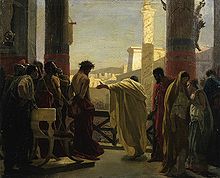
Antonio Ciseri's 1862 depiction of Ecce Homo, as Pontius Pilate delivers Jesus to the crowd
Jesus was crucified by Pontius Pilate, the Prefect of Iudaea province (26 AD to 36 AD). Some scholars suggest that Pilate executed Jesus as a public nuisance, perhaps with the cooperation of the Jewish authorities. Jesus' cleansing of the Temple may well have seriously offended his Jewish audience, leading to his death. while Bart D. Ehrman argued that Jesus' actions would have been considered treasonous and thus a capital offense by the Romans. The claim that the Sadducee high-priestly leaders and their associates handed Jesus over to the Romans is strongly attested. Historians debate whether Jesus intended to be crucified.
The Jesus Seminar argued that Christian scribes seem to have drawn on scripture in order to flesh out the passion narrative, such as inventing Jesus' trial. However, scholars are split on the historicity of the underlying events.
John Dominic Crossan points to the use of the word "kingdom" in his central teachings of the "Kingdom of God," which alone would have brought Jesus to the attention of Roman authority. Rome dealt with Jesus as it commonly did with essentially non-violent dissension: the killing of its leader. It was usually violent uprisings such as those during the Roman-Jewish Wars that warranted the slaughter of leader and followers. As the balance shifted in the early Church from the Jewish community to Gentile converts, it may have sought to distance itself from rebellious Jews (those who rose up against the Roman occupation). There was also a schism developing within the Jewish community as these believers in Jesus were pushed out of the synagogues after the Roman destruction of the Second Temple in 70 AD, see Council of Jamnia. The divergent accounts of Jewish involvement in the trial of Jesus suggest some of the unfavorable sentiments between such Jews that resulted. See also List of events in early Christianity.
Pietro Perugino, Crucifixion of Christ, 1494-1496, Florence
Aside from the fact that the Gospels provide different accounts of the Jewish role in Jesus's death (for example, Mark and Matthew report two separate trials, Luke one, and John none), Fredriksen, like other scholars (see Catchpole 1971) argues that many elements of the gospel accounts could not possibly have happened: according to Jewish law, the court could not meet at night; it could not meet on a major holiday; Jesus's statements to the Sanhedrin or the High Priest (e.g. that he was the messiah) did not constitute blasphemy; the charges that the Gospels purport the Jews to have made against Jesus were not capital crimes against Jewish law; even if Jesus had been accused and found guilty of a capital offense by the Sanhedrin, the punishment would have been death by stoning (the fates of Saint Stephen and James the Just for example) and not crucifixion. This necessarily assumes that the Jewish leaders were scrupulously obedient to Roman law, and never broke their own laws, customs or traditions even for their own advantage. In response, it has been argued that the legal circumstances surrounding the trial have not been well understood, and that Jewish leaders were not always strictly obedient, either to Roman law or to their own.[108] Furthermore, talk of a restoration of the Jewish monarchy was seditious under Roman occupation. Further, Jesus would have entered Jerusalem at an especially risky time, during Passover, when popular emotions were running high. Although most Jews did not have the means to travel to Jerusalem for every holiday, virtually all tried to comply with these laws as best they could. And during these festivals, such as the Passover, the population of Jerusalem would swell, and outbreaks of violence were common. Scholars suggest that the High Priest feared that Jesus' talk of an imminent restoration of an independent Jewish state might spark a riot. Maintaining the peace was one of the primary jobs of the Roman-appointed High Priest, who was personally responsible to them for any major outbreak. Scholars therefore argue that he would have arrested Jesus for promoting sedition and rebellion, and turned him over to the Romans for punishment.
Both the gospel accounts and [the] Pauline interpolation [found at 1 Thes 2:14-16] were composed in the period immediately following the terrible war of 66-73. The Church had every reason to assure prospective Gentile audiences that the Christian movement neither threatened nor challenged imperial sovereignty, despite the fact that their founder had himself been crucified, that is, executed as a rebel.[109]
However, Paul's preaching of the Gospel and its radical social practices were by their very definition a direct affront to the social hierarchy of Greco-Roman society itself, and thus these new teachings undermined the Empire, ultimately leading to full scale Roman persecution of Christians aimed at stamping out the new faith.

Burial and Empty Tomb

Some scholars are split on whether Jesus was buried. Craig A. Evans contends that, "the literary, historical and archaeological evidence points in one direction: that the body of Jesus was placed in a tomb, according to Jewish custom."[110] John Dominic Crossan, based on his unique position that the Gospel of Peter contains the oldest primary source about Jesus, argued that the burial accounts become progressively extravagant and thus found it historically unlikely that an enemy would release a corpse, contending that Jesus' followers did not have the means to know what happened to Jesus' body.[111] Crossan's position on the Gospel of Peter has not found scholarly support,[112] from Meyer's description of it as "eccentric and implausible",[113] to Koester's critique of it as "seriously flawed".[114] Habermas argued against Crossan, stating that the response of Jewish authorities against Christian claims for the resurrection presupposed a burial and empty tomb,[115] and he observed the discovery of the body of Yohanan Ben Ha'galgol, a man who died by crucifixion in the first century and was discovered at a burial site outside ancient Jerusalem in an ossuary, arguing that this find revealed important facts about crucifixion and burial in first century Palestine.[116] Other scholars consider the burial by Joseph of Arimathea found in Mark 15 to be historically probable,[117] and some have gone on to argue that the tomb was thereafter discovered empty.[118] More positively, Mark Waterman maintains the Empty Tomb priority over the Appearances.[119] Michael Grant wrote:
[I]f we apply the same sort of criteria that we would apply to any other ancient literary sources, then the evidence is firm and plausible enough to necessitate the conclusion that the tomb was indeed found empty.[120]
However, Marcus Borg notes:
the first reference to the empty tomb story is rather odd: Mark, writing around 70 CE, tells us that some women found the tomb empty but told no one about it. Some scholars think this indicates that the story of the empty tomb is a late development and that the way Mark tells it explains why it was not widely (or previously) known[121]
Likewise, scholars Gerd Theissen and Annette Merz conclude that "the empty tomb can only be illuminated by the Easter faith (which is based on appearances); the Easter faith cannot be illuminated by the empty tomb."[122]

Resurrection appearances

The Incredulity of Saint Thomas by Caravaggio (16th century), depicts the resurrected Jesus.
Peter, Paul, and Mary apparently had visionary experiences of a risen Jesus.[70] Paul recorded his vision in an epistle and lists other reported appearances. The original Mark reports Jesus' empty tomb, and the later Gospels and later endings to Mark narrate various resurrection appearances.
The two oldest manuscripts (4th century) of Mark, the earliest Gospel, break off at 16:8 stating that the women came and found an empty tomb "and they said nothing to anyone because they were afraid". (Mk 16:8) The passages stating that he had been seen by Mary Magdelene and the eleven disciples (Mk 16:9-20) were added only later, and the hypothetical original ending was lost. Scholars have put forth a number of theories concerning the resurrection appearances of Jesus. The Jesus Seminar concluded: "In the view of the Seminar, he did not rise bodily from the dead; the resurrection is based instead on visionary experiences of Peter, Paul, and Mary."[123] E.P. Sanders argues for the difficulty of accusing the early witnesses of any deliberate fraud:
It is difficult to accuse these sources, or the first believers, of deliberate fraud. A plot to foster belief in the Resurrection would probably have resulted in a more consistent story. Instead, there seems to have been a competition: 'I saw him,' 'so did I,' 'the women saw him first,' 'no, I did; they didn't see him at all,' and so on. Moreover, some of the witnesses of the Resurrection would give their lives for their belief. This also makes fraud unlikely.[124]
Most scholars believe supernatural events cannot be reconstructed using empirical methods, and thus consider the resurrection a non-historical question but instead a philosophical or theological question.[125]

Methods of research

Albert Schweitzer, whose book coined the term Quest for the historical Jesus
In the early church, there were already tendencies to portray Jesus as a verifiable demonstration of the extraordinary. Since the 18th century, scholars have taken part in three separate "quests" for the historical Jesus, attempting to reconstruct various portraits of his life using historical methods. While textual criticism (or lower criticism) had been practiced for centuries, a number of approaches to historical analysis and a number of criteria for evaluating the historicity of events emerged as of the 18th century, as a series of "Quests for the historical Jesus" took place. At each stage of development, scholars suggested specific forms and methodologies of analysis and specific criteria to be used to determine historical validity.
The first Quest, which started in 1778, was almost entirely based on biblical criticism. This was supplemented with form criticism in 1919 and redaction criticism in 1948. Form criticism began as an attempt to trace the history of the biblical material before it was written down, and may thus be seen as starting when textual criticism ends. Form criticism looks for patterns within units of biblical text and attempts to trace their origin based on the patterns. Redaction criticism may be viewed as the child of text criticism and form criticism. This approach views an author as a "redactor" i.e. someone preparing a report, and tries to understand how the redactor(s) has molded the narrative to express their own perspectives.
At the end of the first Quest (c. 1906) the criterion for multiple attestation was used and was the major additional element up to 1950s. The concept behind multiple attestation is simple: as the number of independent sources that vouch for an event increases, confidence in the historical authenticity of the event rises.
Other criteria were being developed at the same time, e.g. "double dissimilarity" in 1913, "least distinctiveness" in 1919 and "coherence and consistency" in 1921. The criterion of double dissimilarity views a reported saying or action of Jesus as possibly authentic, if it is dissimilar from both the Judaism of his time and also from the traditions of the early Christianity that immediately followed him. The least distinctiveness criterion relies on the assumption that when stories are passed from person to person, the peripheral, least distinct elements may be distorted, but the central element remains unchanged. The criterion of "coherence and consistency" states that material can be used only when other material has been identified as authentic to corroborate it.
The second Quest was launched in 1953, and along with it the criterion of embarrassment was introduced. This criterion states that a group is unlikely to invent a story that would be embarrassing to themselves. The criterion of "historical plausibility" was introduced in 1997, after the start of the third Quest in 1988. This principle analyzes the plausibility of an event in two separate components: contextual plausibility and consequential plausibility, i.e. the historical context needs to be suitable, as well as the consequences.
A new characteristic of the modern aspects of the third quest has been the role of archaeology and James Charlesworth states that few modern scholars now want to overlook the archaeological discoveries that clarify the nature of life in Galilee and Judea during the time of Jesus. A further characteristic of the third quest has been its interdisciplinary and global nature of the scholarship. While the first two quests was mostly by European Protestant theologians, the third quest has seen a worldwide influx of scholars from multiple disciplines.
More recently historicists have focussed their attention on the historical writings associated with the period in which Jesus lived or on the evidence concerning his family. The redaction of these documents through early Christian sources till the 3rd or 4th centuries has also been a rich source of new information.

Criticism of Jesus research methods

A number of scholars have criticised Historical Jesus research for religious bias and lack of methodological soundness, and some have argued that modern biblical scholarship is insufficiently critical and sometimes amounts to covert apologetics.

Theological bias

John Meier, a Catholic priest and a professor of theology at University of Notre Dame, has stated "... I think a lot of the confusion comes from the fact that people claim they are doing a quest for the historical Jesus when de facto they’re doing theology, albeit a theology that is indeed historically informed ..."Meier also wrote that in the past the quest for the historical Jesus has often been motivated more by a desire to produce an alternate Christology than a true historical search.
The British Methodist scholar Clive Marsh has stated that the construction of the portraits of Jesus as part of various quests have often been driven by "specific agendas" and that historical components of the relevant biblical texts are often interpreted to fit specific goals. Marsh lists theological agendas that aim to confirm the divinity of Jesus, anti-ecclesiastical agendas that aim to discredit Christianity and political agendas that aim to interpret the teachings of Jesus with the hope of causing social change.
The New Testament scholar Nicholas Perrin has argued that since most biblical scholars are Christians, a certain bias is inevitable, but he does not see this as a major problem.

Lack of methodological soundness

The historical analysis techniques used by biblical scholars have been questioned, and according to James Dunn it is not possible "to construct (from the available data) a Jesus who will be the real Jesus."
W.R. Herzog has stated that "What we call the historical Jesus is the composite of the recoverable bits and pieces of historical information and speculation about him that we assemble, construct, and reconstruct. For this reason, the historical Jesus is, in Meier's words, 'a modern abstraction and construct.'"
Donald Akenson, Professor of Irish Studies in the department of history at Queen's University has argued that, with very few exceptions, the historians attempting to reconstruct a biography of the man apart from the mere facts of his existence and crucifixion have not followed sound historical practices. He has stated that there is an unhealthy reliance on consensus, for propositions, which should otherwise be based on primary sources, or rigorous interpretation. He also identifies a peculiar downward dating creep, and holds that some of the criteria being used are faulty. He says that the overwhelming majority of biblical scholars are employed in institutions whose roots are in religious beliefs. Because of this, more than any other group in present day academia, biblical historians are under immense pressure to theologize their historical work. It is only through considerable individual heroism, that many biblical historians have managed to maintain the scholarly integrity of their work.
Dale Allison, a Presbyterian theologian and professor of New Testament Exegesis and Early Christianity at Pittsburgh Theological Seminary, says, "... We wield our criteria to get what we want ..''
According to James Dunn, "...the 'historical Jesus' is properly speaking a nineteenth- and twentieth-century construction using the data provided by the Synoptic tradition, not Jesus back then and not a figure in history." (Emphasis in the original). Dunn further explains that "the facts are not to be identified as data; they are always an interpretation of the data.
Since Albert Schweitzer's book The Quest of the Historical Jesus, scholars have for long stated that many of the portraits of Jesus are "pale reflections of the researchers" themselves. Albert Schweitzer accused early scholars of religious bias. John Dominic Crossan summarized the recent situation by stating that many authors writing about the life of Jesus "... do autobiography and call it biography.

Scarcity of sources

Bart Ehrman and separately Andreas Köstenberger contend that given the scarcity of historical sources, it is generally difficult for any scholar to construct a portrait of Jesus that can be considered historically valid beyond the basic elements of his life.On the other hand, scholars such as N. T. Wright and Luke Timothy Johnson argue that the image of Jesus presented in the gospels is largely accurate, and that dissenting scholars are simply too cautious about what we can claim to know about the ancient period.

Myth theory

Main article: Christ myth theory
The Christ myth theory is the proposition that Jesus of Nazareth never existed, or if he did, he had virtually nothing to do with the founding of Christianity and the accounts in the gospels. Many proponents use a three-fold argument first developed in the 19th century: that the New Testament has no historical value, that there are no non-Christian references to Jesus Christ from the first century, and that Christianity had pagan and/or mythical roots.
In recent years, there have been a number of books and documentaries on this subject. Some "mythicists" say that Jesus may have been a real person, but that the biblical accounts of him are almost entirely fictional.
The scholarly consensus is that the Christ myth theory has been refuted, and that Jesus indeed existed as a historical figure.